
Artificial intelligence has become one of those technologies that people use long before they fully realize they are using it.
A search engine decides which results are most useful. A phone can improve a photograph automatically. An email service can separate unwanted messages from the inbox. A shopping website can recommend products based on previous activity. Navigation apps can estimate routes and change travel conditions. More recently, generative AI tools have made it possible to ask a computer to explain a topic, summarize a document, create an image, write code, or help organize ideas using ordinary language.
For beginners, this creates an interesting problem.
AI is becoming easier to access while the terminology around it is becoming more complicated.
You may hear artificial intelligence, machine learning, deep learning, neural networks, natural language processing, computer vision, generative AI and large language models mentioned in the same conversation. Although these technologies are related, they do not all mean the same thing.
This guide is designed to make that landscape easier to understand.
Instead of beginning with complicated mathematics, we will start with the basic ideas. You will learn what artificial intelligence means, how machine learning fits inside the larger field, why modern AI systems depend on data and computing power, how generative AI differs from traditional software, where AI is already being used, what its weaknesses are, and what a beginner can realistically do to start learning.
The aim is not to make you an AI researcher after one article.
The aim is to give you a solid foundation from which you can continue learning.
What Does Artificial Intelligence Actually Mean?
Artificial intelligence, commonly called AI, is a broad area of computing concerned with creating systems capable of performing tasks that are associated with human intelligence.
That definition is intentionally broad.
Human intelligence includes many different abilities. A person can recognize a face, understand language, compare alternatives, identify patterns, make predictions, solve problems and adapt to new situations.
Computer systems can be designed to perform some of these activities as well.
For example, an AI-powered application might:
- classify photographs;
- recognize speech;
- translate text;
- identify unusual transactions;
- recommend products;
- predict demand;
- analyze documents;
- generate written content;
- create images;
- assist with software development; or
- help users interact with information.
These examples look very different from one another. That is why AI should not be thought of as a single application or a single type of software.
It is better understood as a broad technological field containing many different approaches.
Another distinction is equally important.
An AI system performing a sophisticated task does not automatically mean that it possesses human consciousness or human understanding. A system can be highly capable within a particular problem while still having significant limitations outside that problem.
This is one reason the phrase “intelligent machine” can sometimes create unrealistic expectations.
Why Does AI Feel So Much More Visible Today?
Artificial intelligence has existed as a research field for decades. The recent explosion of public interest did not happen because the basic idea suddenly appeared.
Several developments came together.
First, the world began producing enormous quantities of digital information.
Second, computing hardware became much more capable.
Third, machine learning techniques improved.
Fourth, organizations developed better infrastructure for storing and processing large datasets.
Finally, modern AI products became much easier for ordinary people to interact with.
A researcher working with an AI model and a student asking a chatbot a question may be interacting with very different systems, but both benefit from advances in algorithms, data and computing.
Generative AI added another major change: the interface.
Traditional software often requires users to learn menus, commands or specialized workflows. Generative systems can accept natural-language instructions.
That makes the technology feel dramatically different even when many of the underlying ideas are part of a much longer history.
The Simplest Way to Think About How AI Works
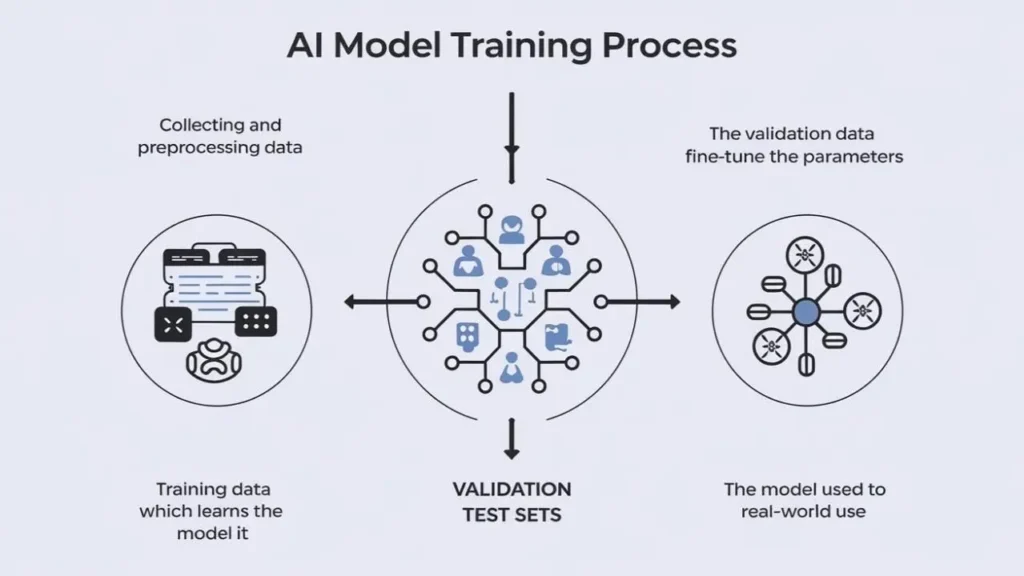
There is no universal recipe followed by every AI system.
However, a simplified model can help beginners:
Data → Training → Model → New Input → Output
Each part has a different role.
Data
Data provides information from which a machine learning system can identify patterns.
Depending on the application, data could be:
- text;
- photographs;
- audio;
- video;
- numerical measurements;
- transactions;
- sensor readings;
- user interactions; or
- structured business records.
Data quality matters.
If the examples used during development are incomplete, inaccurate or poorly representative, the resulting system can inherit some of those weaknesses.
Training
Training is the process of adjusting a model so that it becomes better at a particular task.
The exact mathematics varies considerably between techniques.
For a beginner, the important concept is that the system is not simply being handed a giant list of answers. During training, it adjusts internal parameters based on data and feedback from the training process.
Model
The trained model is the computational system that can later process new information.
Imagine a system designed to recognize whether an image contains a particular object.
During development, it may be exposed to many examples. After training, a new image can be passed through the model and the system can produce a prediction.
The model therefore becomes a kind of learned representation of patterns found during training.
Output
The output depends on the task.
It might be:
- a category;
- a probability;
- a prediction;
- a recommendation;
- generated text;
- an image;
- a transcription; or
- another form of result.
This simplified process is not enough to build an AI system, but it gives beginners a useful mental framework.
Machine Learning: The Part of AI You Will Hear About Most
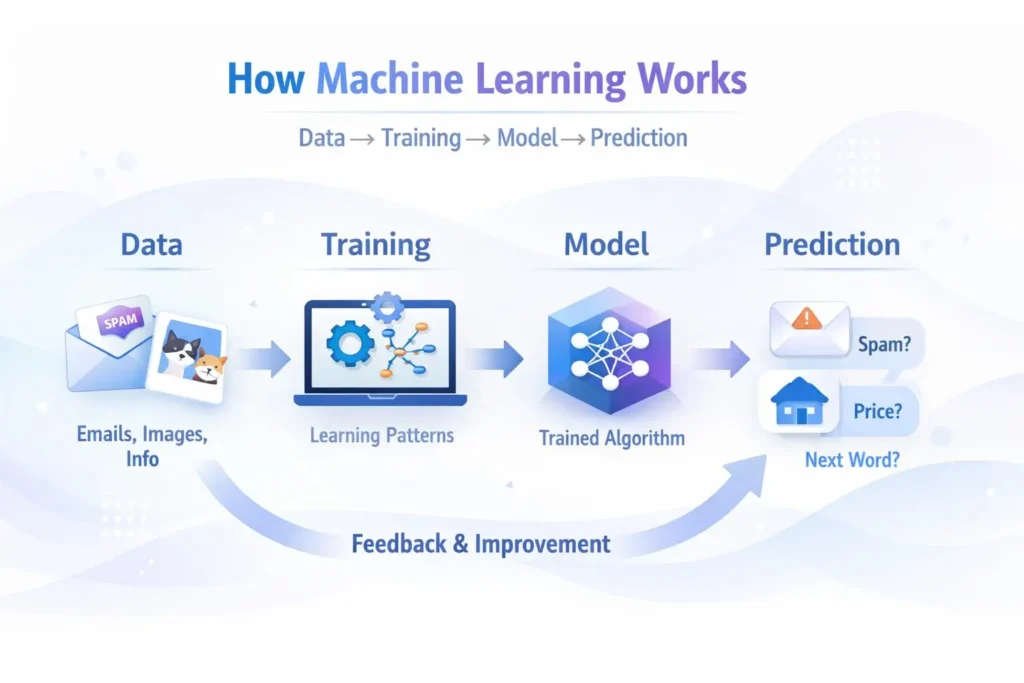
Machine learning is a subset of artificial intelligence in which systems learn patterns from data rather than relying entirely on manually written rules.
Google Cloud describes machine learning as a subset of AI and explains that ML systems can improve as they process more and varied data. It also identifies applications including fraud detection, personalization, recommendations, chatbots, transcription and translation.
Consider an email filtering system.
A conventional rule-based approach might contain instructions such as:
“If the message contains this phrase, move it.”
That approach can work for simple cases, but the number of possible patterns can become enormous.
A machine learning approach can instead use many examples of messages that have already been classified.
The system can learn statistical patterns associated with those examples.
When another message arrives, the trained model can estimate which category is more appropriate.
This distinction is one of the most useful concepts for a beginner:
Traditional programming often tells the computer the rules. Machine learning can allow the computer to learn useful patterns from examples.
That does not mean programmers become unnecessary. People still choose the problem, collect and prepare data, design systems, select methods, evaluate performance and determine how the technology should be used.
Machine Learning, Deep Learning and Neural Networks
These three terms are frequently mixed together.
A simplified relationship is:
Artificial Intelligence → Machine Learning → Deep Learning
Neural networks are a major technology used within deep learning.
IBM similarly describes AI as the broader field, machine learning as a subset of AI, and deep learning as a specialized area of machine learning built around multilayer neural networks.
Neural Networks
A neural network is a computational model made from connected processing units organized into layers.
The terminology was loosely inspired by biological neural systems, but an artificial neural network should not be treated as a literal digital copy of the human brain.
During training, the system adjusts parameters associated with those connections.
A simple network might contain an input layer, intermediate layers and an output layer.
More sophisticated systems can contain enormous numbers of parameters and many computational layers.
Deep Learning
Deep learning generally refers to machine learning based on multilayer neural networks.
It has become particularly important for tasks involving complex patterns and large datasets.
Applications include:
- image recognition;
- speech processing;
- language technologies;
- generative AI;
- robotics; and
- other advanced machine learning applications.
IBM notes that deep learning uses multilayer neural networks and that these systems are used across areas such as computer vision and generative AI.
The beginner takeaway is straightforward:
AI is a broad field. Machine learning is one major approach within AI. Deep learning is a machine learning approach built around multilayer neural networks.
What Is Generative AI?
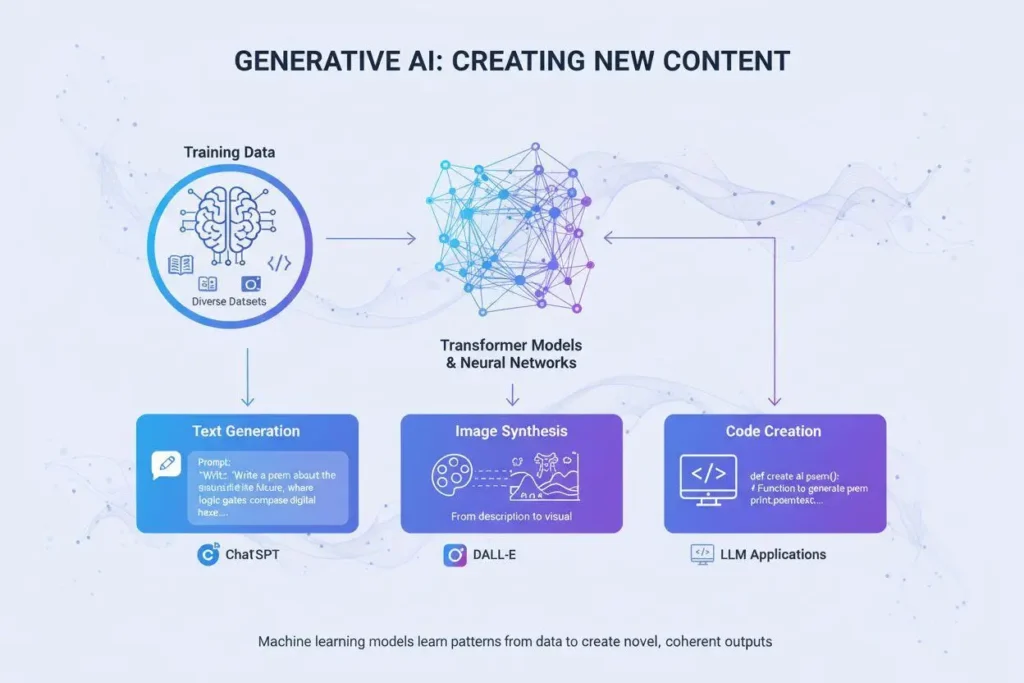
Generative AI is the branch of AI that focuses on producing new content.
Depending on the system, generated material can include:
- text;
- images;
- audio;
- video;
- software code; and
- other digital outputs.
This is different from a system whose primary job is classification.
For example, a traditional machine learning model might estimate whether a transaction looks suspicious.
A generative model might instead produce a written explanation, create an image from a description, or generate a piece of computer code.
That difference is worth remembering.
Prediction and generation are not the same task.
Generative AI has become especially accessible because users can often interact with it through natural language rather than specialized commands.
However, accessibility does not eliminate the need for verification.
A generated paragraph may sound polished while containing an incorrect statement. An image may contain visual errors. Generated code may have a bug.
NIST’s Generative AI Profile was created as a companion to its broader AI Risk Management Framework and focuses specifically on risks associated with generative AI.
Large Language Models Explained Without the Jargon
A large language model, or LLM, is an AI model designed to work with language.
Modern language models can assist with tasks such as:
- answering questions;
- summarizing documents;
- rewriting text;
- translating;
- generating drafts;
- explaining concepts;
- extracting information;
- brainstorming;
- and helping with programming.
At a basic level, a language model learns statistical relationships and patterns in language during training.
When you provide a prompt, the model uses its learned parameters and the context of the request to generate an output.
This explains something that can otherwise seem strange to beginners.
A language model can produce an extremely fluent answer without that answer necessarily being correct.
Fluency is not the same as factual accuracy.
That is why an AI response should be treated as an output to evaluate rather than an unquestionable source of truth.
Natural Language Processing and Computer Vision
Two areas are particularly useful to understand because they appear in many everyday applications.
Natural Language Processing
Natural language processing, or NLP, focuses on enabling computers to work with human language.
Examples include:
- translation;
- text classification;
- speech-related applications;
- document analysis;
- conversational systems;
- summarization; and
- language generation.
The technology behind a modern chatbot may involve several techniques, but the broader goal remains similar: processing and producing human language in useful ways.
Computer Vision
Computer vision focuses on extracting useful information from visual material such as photographs and videos.
IBM describes computer vision as a field that enables machines to process, analyze and interpret visual inputs.
Applications can include:
- object recognition;
- image classification;
- industrial inspection;
- document scanning;
- medical image analysis;
- and video understanding.
When your phone recognizes an object in a photograph or software extracts text from an image, computer vision techniques may be involved.
Recommendation Systems Are AI Too
Many people associate AI exclusively with chatbots.
That is a mistake.
Recommendation systems are another important example.
When an online service suggests:
- a product;
- a video;
- a song;
- an article;
- a movie; or
- another piece of content,
The recommendation may be influenced by algorithms that analyze patterns in user behavior and other information.
The system might consider relationships between users, items, previous interactions and other signals.
You may never see an “AI” label, but sophisticated prediction and pattern-recognition techniques can still be operating behind the scenes.
Narrow AI, AGI and Superintelligence
AI discussions often include three labels: narrow AI, artificial general intelligence and superintelligence.
They should not be treated as interchangeable.
Narrow AI
Narrow AI is designed for specific capabilities or tasks.
A system can be exceptionally good at one problem without possessing broad human-level intelligence.
Most practical AI applications people encounter today fit into this general idea.
Artificial General Intelligence
AGI generally refers to a hypothetical form of AI capable of performing a broad range of intellectual tasks at a much more general level.
It is a much bigger concept than building an excellent image classifier or language model.
Artificial Superintelligence
Superintelligence is an even more hypothetical idea involving capabilities that substantially exceed human intelligence across broad areas.
These concepts are useful when discussing the future of AI, but beginners should separate theoretical ideas from technologies that are actually available and routinely deployed.
Where AI Appears in Everyday Life
You do not need to open an AI chatbot to encounter artificial intelligence.
Search
Search systems process queries and information to help determine which results may be relevant.
Smartphones
Machine learning can be used in photography, speech recognition, text prediction, translation and other mobile features.
Automated systems can help identify spam and suspicious messages.
Navigation
Digital maps process large amounts of information to provide route suggestions and travel estimates.
Online Shopping
Recommendation technologies can help determine which products may be relevant to a customer.
Entertainment
Streaming and social platforms can use recommendation systems to personalize what users see.
Business Software
Organizations increasingly use AI and machine learning for analysis, customer support, document processing, forecasting and automation.
Google Cloud lists fraud detection, security analysis, personalization, recommendations, chatbots, transcription, translation and data analysis among machine learning use cases.
The important lesson is that AI is not a separate corner of the internet.
It is increasingly embedded in ordinary digital services.
How Students Can Use AI Without Losing the Learning Process
AI can be useful in education when the learner remains involved.
Imagine a student studying programming.
Instead of asking an AI system to complete an assignment and submitting the result, the student could ask:
“Explain why this loop produces this output.”
Or:
“Give me three similar exercises without solutions.”
Or:
“Here is my answer. Find the mistake and explain why it is wrong.”
That creates a learning interaction.
The same principle works for mathematics, languages, writing, science and many other subjects.
AI can help with:
- explanations;
- examples;
- practice questions;
- brainstorming;
- feedback;
- revision;
- summarization; and
- study planning.
But there is an important boundary.
Using AI to understand something is different from using AI to avoid understanding it.
The first can strengthen learning.
The second can create dependence.
How Bloggers and Content Creators Can Use AI
AI can also become part of a content workflow.
A writer might use it for:
- topic brainstorming;
- outlining;
- comparing possible structures;
- simplifying complicated wording;
- generating questions readers may have;
- reorganizing notes;
- editing repetitive sentences;
- or creating alternative versions of a draft.
But a responsible publishing process should not look like:
Prompt → Generate → Publish
A stronger workflow is:
Research → Plan → Draft → Verify → Edit → Publish
That difference is especially important for educational websites.
If an article contains a statistic, technical explanation, product specification or important claim, the publisher should check the information before presenting it to readers.
AI can accelerate writing.
It does not transfer editorial responsibility away from the publisher.
How Businesses Can Use AI
Businesses do not necessarily need a huge AI project.
Sometimes the best use case is a small repetitive task.
Examples include:
- organizing documents;
- summarizing internal information;
- assisting customer-service teams;
- analyzing structured data;
- helping sales teams prepare information;
- supporting software development;
- identifying unusual transactions;
- and automating parts of administrative workflows.
The correct question is not:
“Where can we put AI?”
A better question is:
“Which problem is costing us time, money or effort, and could AI help solve it reliably?”
That shift prevents organizations from adopting technology simply because it is fashionable.
Businesses also need to think about security, privacy, accuracy, governance and human oversight.
NIST’s AI Risk Management Framework is intended to help organizations manage AI-related risks and incorporate trustworthiness considerations into the design, development, deployment, use and evaluation of AI systems.
The Benefits of Artificial Intelligence
AI can provide meaningful advantages when applied to an appropriate problem.
Faster Processing
Computers can process large amounts of information much faster than people can manually review every item.
Automation
Repetitive processes can sometimes be automated, allowing people to spend more time on tasks requiring judgment or creativity.
Pattern Recognition
Machine learning can identify relationships and patterns within large datasets.
Personalization
Recommendation systems can tailor results to individual users.
Accessibility
Translation, speech recognition, summarization and other technologies can make information easier to interact with.
Creative Assistance
Generative AI can provide starting points for writing, images, brainstorming and code.
The key phrase is “when applied to an appropriate problem.”
AI is not automatically beneficial simply because it is advanced.
Where AI Can Go Wrong
Understanding weaknesses is essential.
Incorrect Outputs
Generative AI systems can produce false or misleading information.
This is sometimes called hallucination, but the practical lesson is simpler: verify important claims.
A fluent answer can still be wrong.
Bias
AI systems are influenced by data, development choices and evaluation methods.
If problematic patterns exist in the underlying data or process, an AI system may reproduce or amplify them.
NIST’s AI resources include specific work concerning bias and trustworthy AI. [7]
Security Problems
AI systems can interact with broader cybersecurity and software risks.
Sensitive applications require appropriate controls rather than assuming that an AI model will behave safely in every situation.
Lack of Context
An AI model may not know important details about your real-world situation unless those details are available to it.
Even when context is supplied, the resulting answer still requires evaluation.
Overconfidence
Perhaps one of the biggest beginner mistakes is assuming that a confident-sounding response must be accurate.
It does not.
Privacy: What Should You Never Paste Into an AI Tool?
Convenience can make people careless with information.
Before putting data into an AI service, think about what you are sharing.
Be particularly careful with:
- passwords;
- API keys;
- financial credentials;
- private customer records;
- confidential company documents;
- personal identification information;
- private correspondence; and
- other sensitive material.
For organizations, AI usage should ideally be governed by clear policies.
Employees should know which tools are approved and which types of information are prohibited from being entered.
For individual users, a simple rule is useful:
If the information would be inappropriate to share with an unknown online service, do not casually paste it into an AI application.
How to Write Better AI Prompts
Prompt quality matters, but beginners often make it more complicated than necessary.
Compare:
“Explain SEO.”
with:
“Explain basic SEO to someone who has never managed a website. Use simple language, give five practical examples, and organize the answer with clear headings.”
The second instruction gives the system more context.
A useful prompt normally answers several questions:
What is the goal?
Tell the system what you actually want.
Who is the audience?
A beginner and an experienced developer require different explanations.
What context matters?
Provide the information the system needs to understand the task.
What format should the result use?
You can request a table, checklist, outline, explanation or another structure.
What limitations should be followed?
Mention word count, tone, exclusions or required elements when they matter.
You do not need to memorize a complicated “prompt formula.”
Clear instructions and useful context are usually more valuable than trying to sound technical.
Mistakes Beginners Should Avoid
Mistake 1: Treating AI as an Answer Machine
AI is useful for exploration, assistance and generation.
It is not an automatic replacement for verification.
Mistake 2: Learning Too Many Topics at Once
AI contains a huge number of technologies.
Trying to master everything simultaneously can make learning harder.
Mistake 3: Publishing Without Reviewing
Generated material can contain factual mistakes, weak examples and repetitive wording.
Mistake 4: Sharing Sensitive Data
Never sacrifice privacy simply to make an AI prompt more convenient.
Mistake 5: Focusing Only on Prompts
Prompting is useful, but understanding the problem you are trying to solve is more important.
Mistake 6: Confusing Fluency With Intelligence
A well-written response is not proof that the system has correctly understood every aspect of the situation.
A Beginner-Friendly AI Learning Roadmap
You can start learning AI without attempting advanced mathematics on day one.
Step 1: Understand the Vocabulary
Learn the differences between:
- AI;
- machine learning;
- deep learning;
- neural networks;
- generative AI;
- NLP;
- computer vision; and
- large language models.
Step 2: Experiment
Use AI for low-risk tasks.
Ask it to explain a concept.
Generate examples.
Summarize your own notes.
Rewrite a paragraph.
Create practice questions.
The objective is to understand how these systems behave.
Step 3: Learn Verification
Whenever information matters, develop the habit of checking it.
This is especially important for health, finance, law, security, current events and technical specifications.
Step 4: Pick One Direction
Choose something connected to your interests.
For example:
AI + Education
Explore tutoring workflows, study tools and educational applications.
AI + Content
Explore research assistance, editing and content workflows.
AI + SEO
Study how AI can support research, organization and website workflows.
AI + Programming
Learn Python, APIs, data handling and AI application development.
AI + Business
Study workflow automation, document processing, analysis and decision support.
Step 5: Build a Small Project
A small working project teaches more than endlessly reading definitions.
You could create:
- a study assistant workflow;
- an AI-powered content organizer;
- a simple document summarizer;
- a basic chatbot;
- a classification experiment; or
- a small automation.
The project does not need to be revolutionary.
It needs to teach you something.
What Should You Learn After the Basics?
The next stage depends on your objective.
Someone interested in content creation does not need the same curriculum as someone planning to become a machine learning engineer.
If You Want to Work With Content
Focus on research, editing, information verification, content strategy and responsible AI-assisted workflows.
If You Want to Work With SEO
Study search fundamentals, website structure, content quality, structured information and how users discover information.
If You Want to Become a Developer
Learn programming first.
Then move toward APIs, data processing, model integration, databases and machine learning concepts.
If You Want to Work in Business
Learn to identify repetitive processes, calculate the potential value of automation, evaluate AI output and protect sensitive information.
If You Want to Become an AI/ML Specialist
Eventually you will need stronger foundations in programming, mathematics, statistics, data structures, machine learning algorithms and model evaluation.
There is no requirement to learn all of that immediately.
Progress works better when the difficulty increases gradually.
Frequently Asked Questions
Is AI difficult to learn?
The advanced side of AI can be highly technical, but the fundamentals are approachable. Start with the major concepts before moving into mathematics, programming or model development.
Do I need programming experience?
Not to use many existing AI applications. Programming becomes increasingly important if your goal is to build AI-powered software or work with machine learning systems.
Is generative AI the same as artificial intelligence?
No. Generative AI is one area within the much broader field of artificial intelligence.
Can AI provide incorrect information?
Yes. AI-generated output should not automatically be considered verified information.
Can students use AI?
AI can be useful for explanations, examples, practice and feedback. Students should follow their school or institution’s rules and make sure they understand the work they submit.
Is machine learning the same as deep learning?
No. Machine learning is the broader category. Deep learning is a specialized approach that uses multilayer neural networks.
Is AGI already available?
AGI is generally discussed as a hypothetical form of broadly capable artificial intelligence. It should not be confused with today’s specialized or general-purpose AI products.
Can AI replace human judgment?
AI can assist with many tasks, but important decisions still require appropriate human oversight, especially where errors can have serious consequences.
Should bloggers use AI?
AI can support research organization, brainstorming, outlining and editing. Publishers should still verify facts, improve the material and take responsibility for what they publish.
What is the best way to start learning AI?
Start with the vocabulary, experiment with practical tools, learn verification habits, choose one area of interest and build a small project.
Final Thoughts
Artificial intelligence can look intimidating because the field contains so many technologies and so much terminology.
It becomes easier to understand when those ideas are separated.
AI is the broad field.
Machine learning is one important way computers can learn patterns from data.
Deep learning uses multilayer neural networks.
Natural language processing deals with human language.
Computer vision deals with visual information.
Generative AI produces new content.
Large language models are designed to work with language at a broad scale.
These technologies are already connected to ordinary activities such as search, recommendations, digital assistants, image processing, navigation, customer service and content creation.
But capability should not be confused with perfection.
AI systems can make mistakes. They can reflect unwanted patterns in their data. They can introduce privacy and security concerns. A generated response can sound certain even when the underlying information is inaccurate.
That is why learning AI should involve two things at the same time:
understanding what the technology can do and understanding where it can fail.
For beginners, the best starting point is practical curiosity.
Try a tool.
Ask a question.
Test the answer.
Check an important claim against a reliable source.
Change the prompt.
Compare the results.
Then build something small.
You do not need to understand every neural-network architecture before you can benefit from AI. You also do not need to believe that AI is magic.
Treat it as technology that has strengths, weaknesses, trade-offs and real-world consequences.
The more clearly you understand those characteristics, the better prepared you will be to use AI for learning, work, content creation, business and future digital opportunities.
Research & References
This article was prepared using authoritative technical and educational resources to verify the core concepts discussed throughout the guide.
- NIST — Artificial Intelligence Risk Management Framework (AI RMF 1.0)
Guidance for managing risks associated with artificial intelligence and promoting trustworthy AI. - NIST — Artificial Intelligence Risk Management Framework: Generative Artificial Intelligence Profile
Guidance addressing risks and considerations specific to generative AI. - Google Cloud — What Is Machine Learning?
Overview of machine learning, its relationship with AI and common machine learning applications. - IBM — AI vs. Machine Learning vs. Deep Learning vs. Neural Networks
Explanation of the relationship between artificial intelligence, machine learning, deep learning and neural networks. - IBM — What Is Deep Learning?
Background on deep learning, neural networks and their applications. - IBM — What Is Computer Vision?
Overview of computer vision and how AI systems process and interpret visual information. - NIST — AI Risk Management Framework Resources
Additional resources covering trustworthy and responsible AI development and risk management.